10 Questions to Ask Before Investing in Bali

With more developers, projects and return figures entering Bali's property market, knowing how to assess an opportunity has never been more important. Here are 10 questions every investor should ask before choosing a Bali property developer.
Bali property has attracted investors from around the world for years.
But as the market continues to mature, so does the number of developers, projects and investment opportunities competing for attention.
You'll see impressive renders.
You'll see ambitious return projections.
You'll see "guaranteed" income.
And you'll see plenty of reasons to invest now.
But before looking at the return, there is a more important question:
Who are you actually investing with?
Over the years, we've watched the property landscape across the Bukit Peninsula change significantly. Areas that were once early-stage development markets are now attracting more investors, more developers and more capital.
And we've noticed something encouraging in our conversations with investors.
The questions are getting better.
Instead of simply asking, "What return do I get?", sophisticated investors are increasingly asking:
- Who is actually building it?
- What exactly do I own?
- Can I verify the permits?
- Who operates the property?
- Where is the guarantee written?
- What has the developer actually delivered?
Those are the questions that matter.
So if you're considering investing in Bali property, here are 10 questions we believe every investor should ask before choosing a developer.
01 — Who Is Actually Behind the Development?
Don't just look at the project. Look at the company behind it.
Ask:
- Who founded the company?
- How long have they operated in Bali?
- What have they previously developed?
- Are those projects completed and operating?
- How much of the development process do they manage themselves?
Why it matters
Development involves far more than selling units.
Construction, permits, legal structures, finance, handover, hospitality operations and ongoing asset management all have to work together.
The more of that process a developer understands and controls, the more visibility an investor has over what happens after the sales process.
02 — What Have They Actually Delivered?
Look beyond the number of projects being marketed.
Ask to see completed developments.
Better yet, visit them.
Ask:
- How many projects have been completed?
- Are they operational?
- How long have they been operating?
- Can you speak with existing owners?
- Can you see evidence of actual performance?
Why it matters
Past delivery doesn't guarantee future performance, but it gives you something tangible to evaluate.
A developer with completed and operating assets can be assessed on evidence rather than promises alone.
03 — Who Is Building the Property?
Find out who is responsible for turning the renders into a real building.
Ask:
- Who is the main contractor?
- Who supervises construction?
- Who handles quality control?
- Who is responsible if something goes wrong?
- What is the construction timeline?
Why it matters
Development risk doesn't disappear once you've signed a contract.
Construction quality, timelines and project management can all affect the final asset, and ultimately its ability to operate as intended.
04 — Who Will Operate the Property?
If your investment depends on rental income, this question is critical.
Ask:
- Who manages the property after completion?
- Who handles bookings and pricing?
- Who manages guests?
- Who handles maintenance?
- What operational experience does the management company have?
Why it matters
Development and hospitality are two different businesses.
A developer may be able to build a beautiful property, but generating consistent rental income requires an operating business behind it.
05 — What Exactly Do You Own?
"Own a property in Bali" can mean very different things.
Ask:
- Is it whole ownership or fractional?
- Is it freehold or leasehold?
- Whose name holds the ownership interest?
- What is the lease term?
- Is there an extension mechanism?
- What happens when the initial term ends?
- Can the property be resold?
Why it matters
The ownership structure is fundamental to the investment.
You should understand exactly what rights you're purchasing, not simply what the sales material calls it.
06 — What Does the Return Actually Mean?
This is where investors need to look beyond the headline.
If you see:
"10% guaranteed."
Ask:
10% of what? For how long? Under what conditions?
And:
- Is it gross or net?
- Is it guaranteed or projected?
- Is it rental income or total return?
- What costs are deducted?
- What happens after the guaranteed period?
- Can the historical performance be independently verified?
Why it matters
A return percentage without context doesn't tell you very much.
The most useful comparison is between like-for-like numbers backed by clear assumptions and evidence.
07 — Where Are the Permits and Legal Documents?
Don't be afraid to ask for documentation.
Depending on the project, this could include:
- Construction permits
- Land documentation
- Lease agreements
- Ownership structures
- Development agreements
- Relevant corporate documentation
Why it matters
A serious investment should be supported by documents that can be reviewed and, where appropriate, independently verified by your lawyer or advisors.
If you can't verify it, don't simply take it on trust.
08 — What Is the Construction Status?
If you're buying off-plan, understand exactly where the project is today.
Ask:
- Has construction actually started?
- What stage is it at?
- What has already been completed?
- What are the next milestones?
- What is the expected completion date?
- Can you receive regular construction updates?
Why it matters
There's a significant difference between a project that exists primarily in a presentation and one that is physically progressing on site. A project with visible progress gives investors something tangible to evaluate.
09 — Why This Location?
"It's in Bali" isn't an investment thesis.
Bali is made up of very different micro-markets, each with different levels of demand, supply, infrastructure and development.
Ask:
- Why this specific area?
- Who is the target guest?
- What drives demand here?
- How much competing supply exists?
- What infrastructure is changing?
- What does the developer's own operating data show?
Why it matters
Location determines the demand your property can access.
And increasingly, the relevant question isn't simply "Why Bali?"
It's:
"Why here?"
10 — Can They Show You the Data?
Finally, move beyond the pitch.
Ask the developer what evidence they can actually provide.
This could include:
- Historical occupancy
- Rental rates
- Revenue
- Operating costs
- Net yield
- Appreciation
- Guest reviews
- Comparable completed projects
- Independent audits or verification
Why it matters
Projections tell you what could happen. Historical data tells you what has happened.
Neither guarantees future performance, but understanding the difference is essential when evaluating an investment.
The Questions Are Getting Better
One of the things we've found most encouraging as Bali's property market has matured is the evolution of the conversations we're having with investors.
A few years ago, many conversations started with:
"What return can I get?"
Today, we're increasingly hearing:
"How is that return calculated?"
"Is it independently verified?"
"Who operates the property?"
"What exactly do I own?"
"Can my lawyer verify the documentation?"
"What has the developer actually delivered?"
We welcome those questions.
Because the more investors understand how Bali property works, the healthier and more transparent the market becomes.
Recognition Matters, But So Does What's Behind It
As Bali's property market becomes more sophisticated, we believe credibility should be built on more than marketing claims.
We're proud to have been recognised by Luxury Lifestyle Awards as the Best Luxury Property Developer in Indonesia, an external recognition of the work we've been building across Bali.
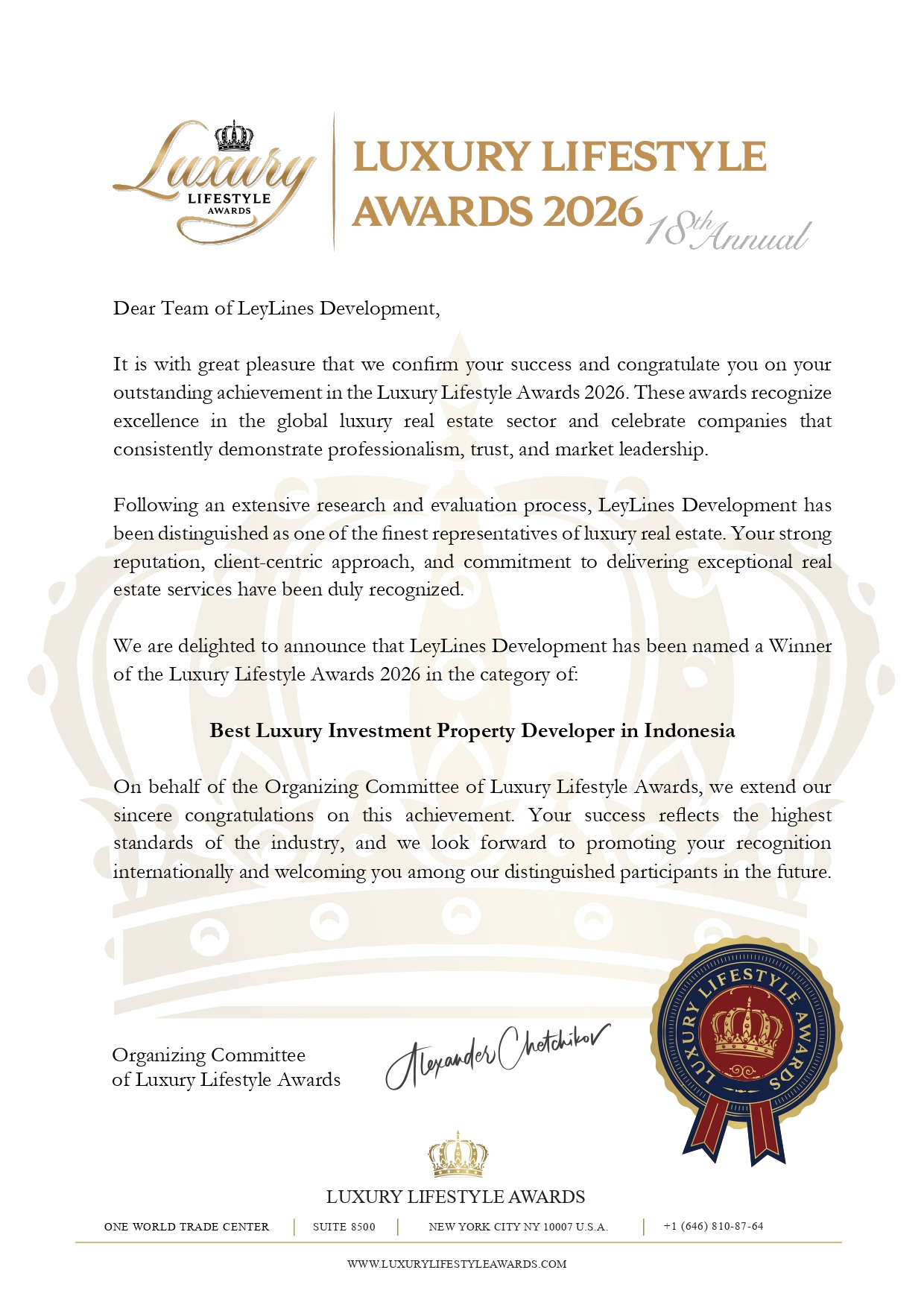
But an award is only one piece of the picture.
For us, the more important questions remain:
What have you actually built? Is it operating? What does the data show? What do the contracts say? Can the documentation be independently verified?
That's why we believe recognition should sit alongside something more tangible:
A documented track record.
Track Record Is Another
Knowing what questions to ask is the first step.
The next is seeing how a developer actually answers them.
At LeyLines, we've been developing and operating across the Bukit Peninsula as the area has evolved from an emerging market into one of South Bali's increasingly recognised property destinations.
Want to see the numbers behind our completed projects?
Get our LeyLines Track Record for historical performance data, completed projects and operating results.
Interested in learning more about investment opportunities in Bali?
EXPLORE OPPORTUNITIES